What Equipment Makes Digging a French Drain Trench Easier?
The trench is only one part of a working drainage system. Before renting a machine, identify where the water begins, where it can legally and safely go, how the trench will maintain its designed grade, and whether the equipment can reach the route.
For many residential French drain projects, a compact mini excavator with a narrow trenching bucket is the most useful primary machine. It can open a controlled trench with less hand digging and place excavated soil beside the route. A mini skid steer can then move aggregate, relocate spoil and assist with cleanup. Design the drain and outlet first; the equipment should serve that plan.
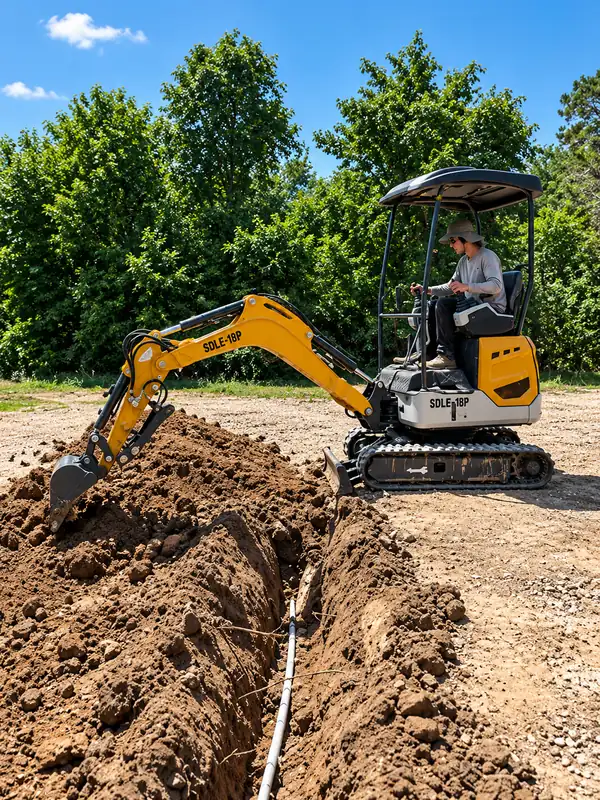
The SDLANCH SDLE18P mini excavator is a strong starting point for a residential French drain trench. Its current rental lineup includes a 16-inch digging bucket, with an 8-inch trenching bucket available for $20 per day and a 30-inch cleanout bucket available for $20 per day. The machine is approximately 43.3 inches wide, and Noble recommends a clear gate opening of at least 44 inches.
A French Drain Needs a Water Plan Before It Needs a Trench
A French drain is not simply a ditch filled with rock. It is a subsurface drainage path intended to intercept or collect water and carry it toward a suitable outlet or infiltration area. Some residential systems use perforated pipe surrounded by clean aggregate and filter material; others are aggregate-filled trenches designed for a specific site. The correct layout depends on the source of the water, soil, elevation, nearby structures, discharge location and local requirements.
Begin by observing the property during rainfall. Mark where water enters, where it ponds and where it already tries to leave. Confirm whether the problem is surface runoff, roof discharge, seepage, an irrigation leak or another source. A trench placed in the visually wettest spot can fail if it does not intercept the actual flow path or has nowhere dependable to discharge.
NRCS drainage guidance emphasizes that subsurface drain location, depth and spacing depend on site conditions, and that the outlet must be adequate for the water being discharged. That is the central planning lesson for a homeowner project: do not dig first and try to invent the outlet later.
Decide the Trench Dimensions Before Choosing a Bucket
The narrowest available bucket is not automatically the best bucket. The trench must accommodate the selected pipe, aggregate envelope, filter material, connections and any working room required by the installation. A narrow trench may reduce excavation and backfill, but it can also make bedding, pipe placement and corrections difficult if the design needs more space.
Choose the drainage system first. Use the pipe and material manufacturer’s installation requirements, or a site-specific plan from a qualified drainage professional when the consequences of failure are significant. Once the required width and depth are known, select the bucket that creates that trench efficiently without removing unnecessary soil.
Noble’s SDLE18P and RIPPA NDI15 mini excavator both currently offer an 8-inch trenching bucket for $20 per day. Each machine includes a 16-inch digging bucket, which provides more working room when the design calls for a wider trench. A 30-inch cleanout bucket is also available for broader cleanup, grading and loose-material work. The auger is not the correct attachment for cutting a continuous French drain trench.
Why a Mini Excavator Works Well for Residential Trenching
Controlled excavation
A mini excavator allows the operator to remove soil in short sections while watching the planned line and depth. The boom can place spoil consistently on one side, leaving the other side open for pipe, aggregate and foot traffic. That organization matters because a trench becomes harder to work around when spoil is scattered on both sides.
Compact access
Residential drainage routes often run beside fences, houses or landscaping. The SDLE18P is listed at approximately 43.3 inches wide, with a recommended clear opening of 44 inches or more. The RIPPA NDI15 has an approximate minimum width of 40.5–41 inches and a recommended clear gate opening of 42 inches or more. Measure the entire route, including hinges, corners, utility equipment, roof overhangs and the space needed to turn—not just the gate opening.
Backfill and cleanup options
Both excavators have a front blade that can help with light backfilling and surface cleanup after the drainage components are installed. A wider cleanout bucket can help handle loose soil, but it does not turn the excavator into a precision finish-grading machine. Preserve topsoil separately when practical and expect hand work around pipe connections, walls, irrigation and final landscaping.
Where a Mini Skid Steer Helps
The excavator opens the trench; the ZJ-380 mini skid steer is better suited to repeated material movement. Its included general-purpose bucket can carry drainage aggregate from the delivery pile, relocate excavated soil and help spread loose material near the work area. The current rental page lists the machine at approximately 41–43 inches wide, while its bucket is approximately 44–45 inches wide depending on configuration.
Bringing two machines only makes sense when the volume and site justify it. For a short trench, staging aggregate in wheelbarrows may be simpler. For a longer route or a delivery pile far from the trench, the mini skid can save substantial handling time. It is still important to protect vulnerable surfaces and keep it away from an open trench edge that may not support the machine.
Plan the Work in the Right Order
- Diagnose the water source. Watch the site during rain and rule out plumbing or irrigation leaks before assuming the answer is a French drain.
- Choose a suitable destination. Confirm where collected water can safely and lawfully go without eroding the property, affecting a neighbor or sending water toward a structure.
- Design the system. Select the pipe, aggregate, filter material, width, depth, cleanouts and outlet protection before choosing attachments.
- Request utility locates. Contact Texas811 and separately identify private lines and systems not covered by the public locate.
- Measure machine access. Check the narrowest opening, turns, slopes, overhead obstacles and ground that must support the machine.
- Mark line and grade. Use a dependable elevation method. Do not judge a drainage grade by eye over a long run.
- Stage materials and spoil. Keep aggregate close enough to reach without blocking the excavator or burying the outlet route.
- Excavate in manageable sections. Maintain a clear side for installation and avoid leaving an open trench unattended.
- Install to the selected design. Keep soil out of clean aggregate, protect connections and confirm flow before closing the trench when the design allows testing.
- Backfill and stabilize the surface. Restore the route so runoff does not create a new erosion channel along the trench.
Call Texas811 Before Any Excavation
Texas811’s homeowner guidance says the homeowner or contractor must contact 811 two business days, excluding weekends and holidays, before digging. Wait for affected utilities to respond, compare those responses with the ticket, respect the markings and dig carefully around marked facilities.
An 811 ticket does not guarantee that every buried item on private property will be marked. Texas811 explains that private utilities can include buried lines after the meter or main line. Irrigation, low-voltage lighting, septic components, propane lines and other privately installed systems may require a private locator or records from the installer. Never use an assumed straight line between two visible points as a utility map.
Important: The excavator bucket can reach a buried line before the operator feels meaningful resistance. Finish the locate process and identify private facilities before bringing the machine to the trench route.
Grade and Outlet Matter More Than Digging Speed
A gravity drain needs a continuous path toward its outlet. A trench that rises, sags or ends at an unsuitable location can hold sediment and water instead of moving it. The correct grade is not a universal number that should be guessed from a generic article; it depends on pipe, flow, site elevations and the system design. Use a laser level, builder’s level or another suitable method to establish and recheck elevations.
The outlet must remain open and resist erosion, root intrusion, animal entry and physical damage as appropriate to the design. NRCS guidance for subsurface drains specifically calls for an outlet adequate for the expected quantity and quality of water and for protection against erosion and undermining. A drain that moves water efficiently but releases it onto an unstable slope has merely transferred the problem.
Some sites do not have enough fall for a simple gravity system. Others cannot accept additional infiltration near a foundation, retaining wall or slope. Those are design problems, not reasons to dig a deeper trench blindly. If the outlet or downstream effect is uncertain, get site-specific drainage help before excavation.
Rent It Yourself or Add an Operator?
DIY rental can make sense when the route is open, utilities are clearly resolved, elevations are established and the renter already understands compact excavator controls. Noble currently lists either mini excavator at $150 for four hours or $200 for eight hours. Customer pickup in Leander is free with an appropriately sized and rated trailer; delivery is available based on the job-site location. A $50 non-refundable reservation deposit holds the date.
Operator service is currently listed at $100 per hour for both the SDLE18P and RIPPA NDI15. It is worth considering when access is tight, the trench runs near a structure or marked utilities, precise grade control is critical, the ground is difficult or the renter is inexperienced. Adding an operator does not replace a drainage design. Provide the operator with the planned line, elevations, required dimensions and verified utility information.
The SDLE18P’s optional quick disconnect is a $5 flat charge per rental and can be useful when the plan requires switching between the 8-inch trenching bucket, 16-inch digging bucket and 30-inch cleanout bucket. The auger and concrete breaker are shared between Noble’s two mini excavators and are subject to shared availability, but neither is automatically needed for a standard French drain trench.
Common French Drain Equipment Mistakes
- Renting before designing. The bucket arrives before the trench width, depth or outlet has been decided.
- Choosing the narrowest bucket by default. The excavated trench does not leave room for the actual drainage assembly.
- Ignoring machine access after the gate. The excavator passes through the opening but cannot turn or work along the planned route.
- Mixing topsoil with trench spoil. Good surface soil becomes difficult to restore after it is blended with subsoil and rock.
- Stacking spoil on both sides. Installers lose their safe, clean working side.
- Relying on sight for grade. Small elevation errors become low spots over a long run.
- Leaving aggregate in the driveway plan. The delivery pile blocks the equipment route or traps a vehicle.
- Forgetting the outlet. The trench is complete, but the collected water has no protected destination.
- Assuming 811 marks private systems. Irrigation or septic components remain in the path.
Planning a French Drain Project in Leander
Before requesting equipment, gather the trench length, planned width and depth, gate measurements, route photos, surface type, selected outlet and a list of attachments. Confirm whether excavated soil will remain onsite or must be moved. Have pipe, aggregate, filter material and fittings ready before the rental begins so the machine is not waiting on missing materials.
Noble Construction serves Leander, Jonestown, Lago Vista, Cedar Park, Liberty Hill, Georgetown and surrounding Central Texas communities. Compare the SDLE18P mini excavator, RIPPA NDI15 mini excavator and ZJ-380 mini skid steer, or visit the Project Advice hub for related planning guides.
Frequently Asked Questions
What machine is best for digging a French drain trench?
For many residential projects, a compact mini excavator with a narrow trenching bucket is the most direct choice because it can excavate a consistent path and place spoil beside the trench. The right machine still depends on access, trench design, utilities, ground conditions and the outlet plan.
Is an 8-inch trenching bucket right for every French drain?
No. An 8-inch bucket can reduce excavation for some narrow designs, but the required trench width depends on the pipe, aggregate, filter material, soil and drainage design. Choose the system first, then choose the bucket.
Do I need to contact 811 before digging a French drain in Texas?
Yes. Texas811 says homeowners or contractors must contact 811 two business days, excluding weekends and holidays, before digging. Private lines such as irrigation, septic components and some service lines may need separate locating.
Can a mini skid steer help with a French drain project?
Yes. A mini skid steer with a bucket can move aggregate, haul excavated soil and help with surface cleanup when access permits. It does not replace the excavator for trenching and should not be treated as precision drainage-design equipment.
Should I rent the excavator or use an operator?
DIY rental may fit an open, clearly marked project with straightforward access and an experienced operator. Operator service is the better question to ask when the trench is near utilities or structures, access is tight, grade must be controlled carefully or the renter is unfamiliar with the machine.
Research & Sources
- Texas811: Homeowner Guide—Call 811 Before You Dig
- Texas811: Frequently Asked Questions, including private utilities
- USDA NRCS: Subsurface Drain Conservation Practice Standard
- U.S. EPA: Stormwater Best Management Practice Design Guide