Mini Skid Steer vs. Full-Size Skid Steer for Residential Landscaping
The right loader is the smallest machine that can reach the work area and still complete the job efficiently. Compare access, material volume, ground conditions, transport and operator experience before choosing.
Choose the ZJ-380 mini skid steer when the project depends on tight backyard access, a smaller work zone and moving loose landscape material with a bucket. Choose the CAT 259D compact track loader when access is wide and strong enough, the project involves larger-volume loading or grading, and the extra machine size will save meaningful time. A bigger machine is not automatically better on a residential property.
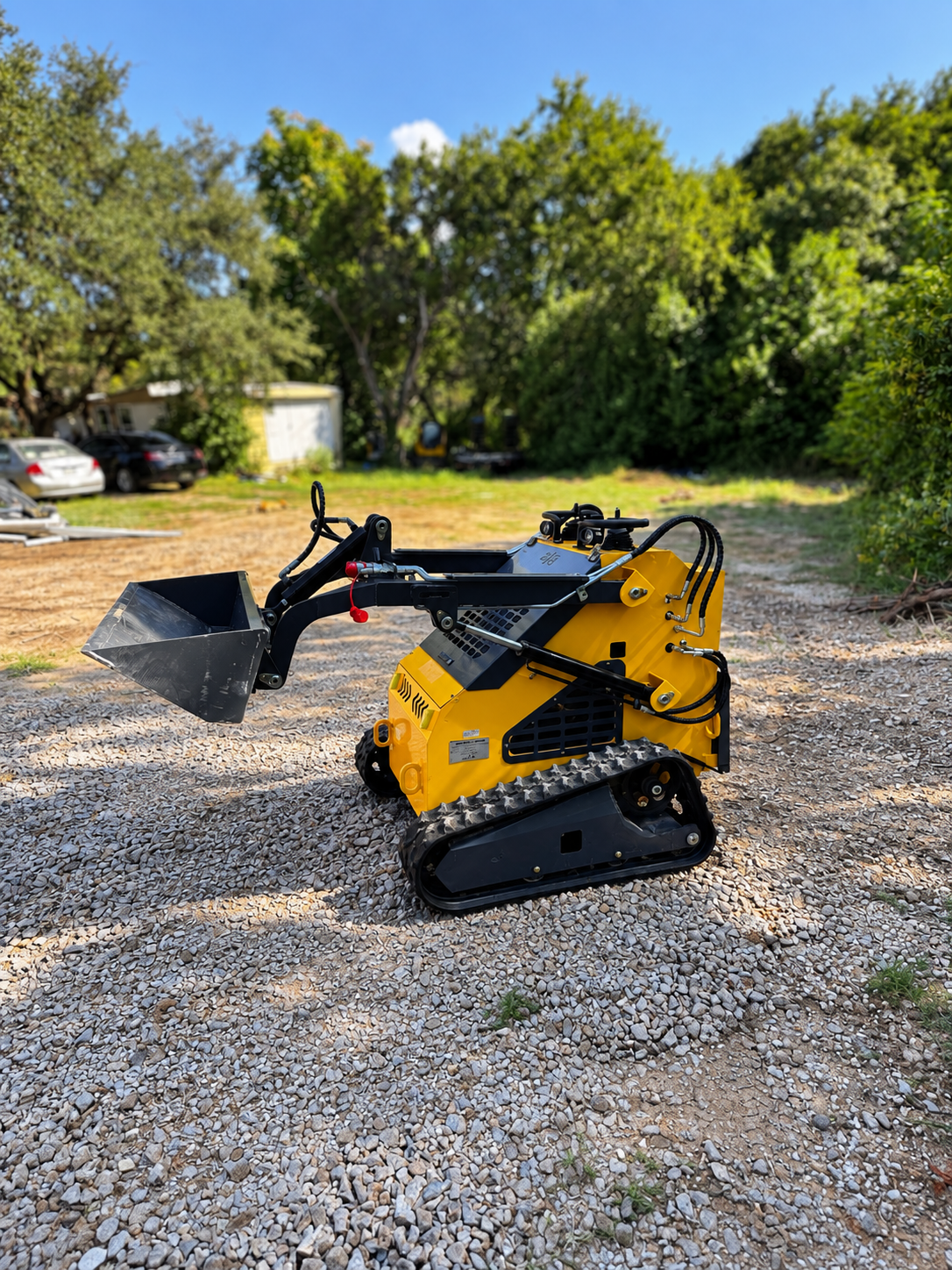
For most gated backyard landscaping, start by checking whether the ZJ-380 mini skid steer fits the route. Noble lists it at approximately 41–43 inches wide with a roughly 44–45-inch bucket. For open sites, larger material quantities, driveway work or heavier grading, compare the CAT 259D compact track loader, which is listed at approximately 66–69 inches wide depending on its track configuration.
Start With the Route, Not the Machine
Homeowners often compare loaders by power first, but residential landscaping is usually limited by access. A machine that cannot pass the side yard, turn around the air-conditioning unit or enter the work area is not useful no matter how much it can move. Measure the complete route before discussing the job.
Check the clear gate opening with hinges, latches and posts included. Then measure the narrowest point after the gate. Look for roof overhangs, meters, fences, trees, drainage features, retaining-wall edges, steps and tight corners. The machine also needs space to turn and to place or load material once inside the yard.
The ZJ-380 rental page lists a published machine width of approximately 41–43 inches depending on build, but its bucket is approximately 44–45 inches on common configurations. Measure for the widest part that must travel through the route, not just the tracks. The CAT 259D page lists a published machine width of 66 inches with narrower tracks or 69 inches with wider tracks, and its working envelope is larger than that number.
The Size Difference Changes the Whole Project
Noble’s current pages list the ZJ-380 at approximately 1,600 pounds and the CAT 259D at approximately 8,846–8,945 pounds depending on track configuration. That is not a minor step up. It affects transport, driveway loading, lawn impact, turning space and how cautiously the machine must be staged around residential improvements.
The mini skid steer is built around compact movement. Its included general-purpose bucket is suited to dirt, gravel, mulch, bed preparation, small-area rough grading and cleanup. It is useful when material arrives at the driveway but must travel through a narrow route to a backyard.
The CAT 259D is a full-size compact track loader. Its current page describes it as a vertical-lift machine for larger grading, loading, dirt work, land clearing and material handling. The extra size can improve production on an open site, but it also demands more room and stronger surfaces. Using it for a small bed refresh can create more restoration work than it saves.
Choose the Mini Skid Steer When Access Controls the Job
Gated backyard material movement
Mulch, topsoil and decorative gravel are often delivered where a truck can reach, not where the material belongs. When the route is narrow, the mini skid can replace repeated wheelbarrow trips while staying within a smaller footprint. The backyard gravel-moving guide explains how pile placement and route planning affect the job.
Small landscape beds and lawn renovation
The smaller machine is easier to position around beds, fences and existing landscape features. It can carry loose material, remove old mulch and help rough-grade a modest area. It does not eliminate finish work. Expect hand raking around irrigation, edging, walls and final elevations.
Short rental windows
The ZJ-380 page lists $125 for up to four consecutive hours and $175 for up to eight hours. That can fit a prepared residential project where material is already delivered, the route is clear and the operator knows exactly where each load goes. The page currently lists the bucket as the only offered attachment, so plan the project around bucket work rather than assuming forks, a grapple or specialty tools are available.
Choose the CAT 259D When Production Justifies Its Size
Open-site grading and larger pads
A full-size tracked loader makes more sense when the machine can work without threading through a finished backyard. Driveway repair, larger rough-grading areas, open building pads and substantial material piles can benefit from the CAT’s larger working scale. The existing gravel driveway grading guide explains why reshaping drainage and surface profile matters more than simply filling ruts.
Repeated loading and material handling
If the job involves repeatedly loading a trailer, relocating a large stockpile or moving material across an open property, the larger loader can reduce the number of cycles. That advantage disappears if every pass requires delicate maneuvering around landscaping or if the machine must work from the edge because the site cannot support it.
Operator-assisted work
The CAT 259D page lists the machine at $300 per full rental day. Machine-only rental is limited to experienced applicants who complete the renter application and receive approval. Operator service is listed at $100 per hour in addition to the machine rental. That option can be valuable when the project needs a full-size machine but the property owner does not have the experience to use it safely or efficiently.
Compare the Machines by the Actual Task
Moving mulch, soil or gravel
For a small or medium quantity behind a gate, the mini skid is usually the practical choice. For a large stockpile on an open route, the CAT may complete the work with fewer cycles. Keep the receiving area in mind: a large machine can move material quickly but still needs enough room to dump and spread it without contacting fences, trees or structures.
Rough grading
Both machines can spread loose material and perform rough grading with a bucket. The mini skid fits smaller residential areas; the CAT is more productive on larger open areas. Neither machine determines the correct finished elevation. Establish drainage goals, protect foundations and utilities, and leave room for topsoil, sod, pavement or other finish materials.
Landscape demolition and cleanup
The bucket-only ZJ-380 can scoop loose mulch, soil and manageable debris. It should not be advertised as having a grapple or demolition attachment that Noble does not currently offer. The CAT page lists a general-purpose bucket and an auger by request; it also requires approval for any attachment. Choose removal methods based on the material rather than assuming the loader can safely tear out every feature.
Working near finished surfaces
The mini skid’s lighter weight can reduce the scale of potential disturbance, but it can still rut turf, turn up sod and mark vulnerable pavement. The CAT 259D’s page specifically warns that even with rubber tracks, the heavy machine can damage turf, irrigation, soft ground and pavement edges. Use a planned route, avoid unnecessary counter-rotation and postpone work when soil cannot support the machine.
Ground Conditions Matter More Than Track Type
Rubber tracks do not make either loader harmless. Wet soil can rut under repeated passes. Recently installed sod can shift. Irrigation heads and shallow lines can break. Thin pavement edges, pavers and poorly supported flatwork can be damaged by turning or concentrated loads.
Walk the route before bringing in equipment. Identify soft areas, slopes, drainage inlets, septic components, utility covers and recently filled trenches. Decide whether temporary surface protection is appropriate, but do not assume a mat makes an inadequate surface structurally safe. Keep the machine away from unsupported excavation edges and abrupt drop-offs.
If the landscaping work includes digging, augering, trenching or disturbing the ground, contact Texas811 at least two business days before work, excluding weekends and holidays. Public locating may not identify private irrigation, low-voltage lighting, pool lines or other owner-installed facilities, so those may need separate identification.
Transport and Delivery Can Decide the Choice
The ZJ-380 page permits customer pickup when the trailer, tow vehicle and securement setup are properly rated for the machine. Delivery and pickup are also available by location. Because the mini skid is listed at about 1,600 pounds, it is more transportable than the CAT, but the total load still includes the trailer and all equipment. Ratings and securement must be verified rather than estimated.
The CAT 259D requires a different transport plan. Its current page allows delivery by location and says any customer transport must be approved with a properly rated truck, trailer, hitch, brakes and securement setup for the machine, attachments and trailer weight. Do not compare towing needs using machine weight alone.
For many homeowners, delivery is the simpler way to separate the landscaping decision from the hauling decision. Confirm where the delivery vehicle can safely unload and whether the machine can travel from that point to the work area.
Plan the Work Before the Rental Clock Starts
- Define the finished result. Mark the area, final elevations and where material will be placed or removed.
- Measure the entire route. Record gates, corners, overhead limits and turning space.
- Estimate the material flow. Know where delivery piles, debris and trailers will sit.
- Review ground conditions. Identify soft soil, slopes, irrigation and vulnerable surfaces.
- Complete utility locating. Contact 811 and identify private facilities when ground disturbance is involved.
- Select the smallest productive machine. Choose access first, then decide whether larger production is worth the added size.
- Prepare hand tools and finish work. Machines move bulk material; rakes, shovels and careful hand work finish the edges.
DIY Rental vs. Operator Service
The ZJ-380 is the more approachable rental for a prepared, open residential project, but the current page does not advertise operator service. Do not assume an operator is included. The renter still needs to understand the controls, inspect the site, keep bystanders clear and use the machine within its limitations.
For the CAT 259D, machine-only rental requires application and approval. Noble’s listed operator option is $100 per hour added to the $300 full-day machine rate. Operator service is the better fit when the project requires full-size production but involves tight tolerances, unfamiliar grading, challenging slopes or a property owner without verified experience.
Regardless of machine size, keep people and pets outside the operating area. Never carry riders in the bucket or on the machine, and never allow someone to stand between the loader and a wall, vehicle or other fixed object. OSHA’s struck-by guidance emphasizes the hazard created by moving heavy equipment; a residential yard is not exempt from that basic risk.
A Simple Decision Rule
Choose the mini skid steer when the route is narrow, the work is concentrated in a backyard, the material quantity is manageable and the included bucket matches the job. Choose the CAT 259D when the route and surfaces support a much heavier machine, the area is open, and larger-scale grading or loading will produce a real time advantage.
If both machines fit, compare the full project rather than the hourly impression. Include rental duration, delivery, surface protection, cleanup, operator requirements and the amount of hand finishing that remains. The cheapest machine is not the one with the lowest listed rate; it is the one that completes the project without avoidable damage, idle time or a second rental.
For more equipment-first planning, visit the Project Advice hub. Noble Construction serves Cedar Park and nearby Central Texas communities with compact equipment rentals, delivery options and CAT 259D operator service.
Frequently Asked Questions
What is the main difference between a mini skid steer and a full-size skid steer?
The practical difference for a residential project is access versus production. Noble’s ZJ-380 mini skid steer is approximately 41–43 inches wide and about 1,600 pounds, while the CAT 259D page lists approximately 66–69 inches of machine width and about 8,846–8,945 pounds depending on configuration.
Which machine is better for moving mulch or topsoil through a backyard?
The mini skid steer is usually the better starting point when the route is narrow, the material must pass through a residential gate or the work area is small. The CAT 259D becomes more useful when access supports it and the project rewards larger-scale loading, grading or repeated material movement.
Will rubber tracks prevent lawn or driveway damage?
No. Rubber tracks can help distribute machine weight, but either machine can rut soft soil, disturb turf or damage pavement edges. The CAT 259D rental page specifically warns that its weight can damage turf, irrigation, soft ground and pavement edges.
Can I pick up either machine myself?
The ZJ-380 page permits customer pickup with a properly rated trailer, tow vehicle and securement setup. CAT 259D customer transport requires approval and equipment rated for the machine, attachments and trailer weight. Delivery is available by location for both.
Should I rent the CAT 259D or use operator service?
The current CAT 259D page says machine-only rental requires an application and approval for experienced operators. Operator service is available for $100 per hour in addition to the machine rental. Choose operator service when the site, grading or machine size exceeds your experience.
Research & Sources
Measure the route, then compare the rental.
Review the current equipment details, transportation options and operator requirements before reserving.